
Table of Contents
Seeing your newborn’s skin or eyes turn yellow can be frightening for any parent. You may immediately wonder, “Is my baby sick?” or “Does my newborn need urgent treatment?” The good news is that newborn jaundice is common, and many babies develop mild jaundice during the first few days after birth. However, jaundice in newborn babies should never be ignored because some cases require careful monitoring, bilirubin testing, or medical treatment.
Understanding Newborn Jaundice Symptoms, why jaundice occurs, and when to seek medical attention can help parents make informed decisions about their baby’s health.
If you are searching for Newborn Jaundice in Solapur, this guide explains what parents should know about newborn jaundice, Bilirubin Levels in Newborn Babies, possible causes, warning signs, treatment options, feeding, and when your baby may need assessment by a pediatrician or neonatologist.
Dr. Shashikant Wali is a Consultant Neonatologist & Pediatric Intensivist in Solapur with expertise in newborn care, NICU care, premature baby care, high-risk newborn care, and pediatric critical care. His approach focuses on helping parents understand their baby’s condition while providing timely, evidence-based medical care when needed.
What Is Newborn Jaundice?
Newborn jaundice is a condition in which a baby’s skin and the whites of the eyes become yellow. This yellow color happens because of an increased amount of a substance called bilirubin in the baby’s blood.
Bilirubin is produced naturally when the body breaks down old red blood cells. The liver normally processes bilirubin and helps remove it from the body through stool and urine.
In newborn babies, however, the liver may not yet be mature enough to process bilirubin as efficiently as an older child’s or adult’s liver. As a result, bilirubin can temporarily build up in the bloodstream and cause yellowing of the skin.
Mild jaundice is common in newborns, particularly during the first week of life. In many healthy babies, it improves as the baby’s liver matures and feeding becomes well established.
However, not all jaundice is harmless. The timing of jaundice, how quickly it is increasing, the baby’s age, gestational age, feeding pattern, and Bilirubin Levels in Newborn Babies all influence whether medical assessment is necessary.
How Common Is Jaundice in Newborn Babies?
Newborn jaundice is one of the most common conditions seen during the early days of life.
It can occur in:
- Full-term newborn babies
- Premature babies
- Babies with feeding difficulties
- Babies who are not getting enough breast milk
- Babies with blood group incompatibility
- Babies with certain infections or medical conditions
Most cases are mild and improve with appropriate feeding and monitoring. However, premature babies and medically vulnerable newborns may require closer observation because their risk of complications can be higher.
This is why parents should understand the difference between normal newborn jaundice and jaundice that needs prompt medical evaluation.
Why Do Newborn Babies Develop Jaundice?
There are several reasons why newborns are more likely to develop jaundice.
1. An Immature Liver
A newborn’s liver is still developing. It may take time for the liver to efficiently process and remove bilirubin.
This is one of the main reasons why healthy babies can develop temporary jaundice after birth.
2. Increased Breakdown of Red Blood Cells
Newborn babies naturally have a higher number of red blood cells compared with adults. These cells are also broken down more quickly.
As red blood cells break down, bilirubin is produced. If bilirubin production is faster than the baby’s liver can process it, the bilirubin level can increase.
3. Feeding Difficulties
Some babies may not feed effectively during the first few days after birth.
If a baby is not getting enough milk, bowel movements may be less frequent. Because bilirubin leaves the body partly through stool, reduced feeding and bowel movements can contribute to higher bilirubin levels.
This does not mean that breastfeeding should be stopped. In most situations, breastfeeding should be continued, with appropriate feeding support and medical advice when necessary.
4. Premature Birth
Premature babies may have less mature livers and may be more vulnerable to complications related to high bilirubin levels.
Parents of premature babies should follow their neonatologist’s recommendations for feeding, monitoring, and follow-up.
For parents looking for information about specialized newborn care, Dr. Shashikant Wali also provides guidance related to NICU care in Solapur.
5. Blood Group Incompatibility
Sometimes, differences between the mother’s and baby’s blood groups can cause increased breakdown of the baby’s red blood cells.
This can lead to a faster rise in bilirubin and may require closer medical monitoring.
6. Other Medical Conditions
Less commonly, jaundice may be associated with:
- Infection
- Red blood cell disorders
- Liver problems
- Certain metabolic conditions
- Problems affecting bilirubin processing
For this reason, persistent, severe, or unusually early jaundice should be evaluated by a medical professional.
What Are the Common Newborn Jaundice Symptoms?
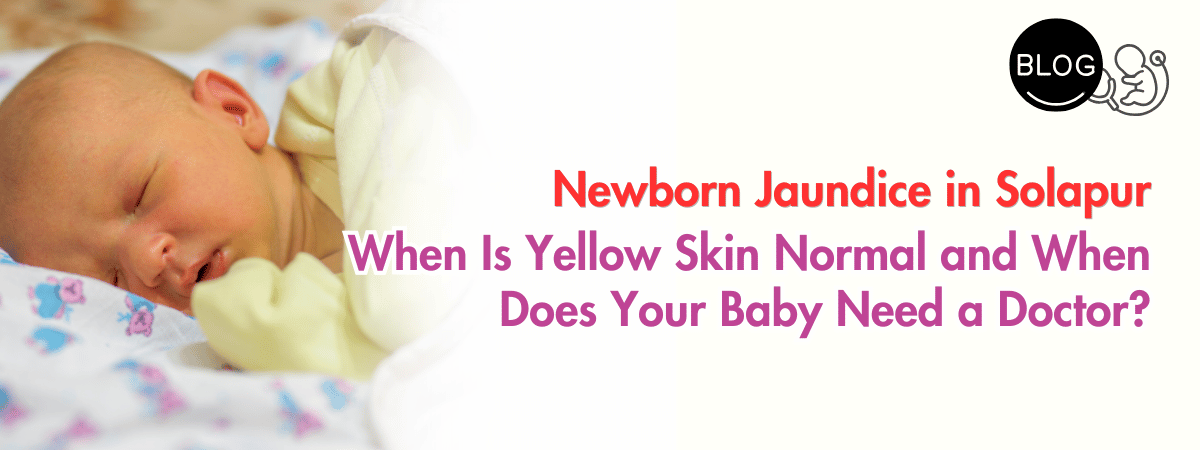
The most noticeable symptom is yellow discoloration of the skin or eyes.
Common Newborn Jaundice Symptoms include:
- Yellow skin
- Yellowing of the whites of the eyes
- Yellow color beginning on the face
- Yellowing spreading toward the chest or body
- Baby appearing more yellow over time
Jaundice often becomes easier to notice in natural daylight.
Parents should never rely only on the intensity of yellow skin to determine how high the bilirubin level is. A baby’s bilirubin level cannot be accurately estimated just by looking at the skin.
If jaundice is suspected, a healthcare professional may recommend bilirubin measurement using a skin device or a blood test, depending on the baby’s age and clinical situation.
When Is Newborn Jaundice Usually Considered Normal?
Many healthy newborns develop what is commonly called physiological jaundice.
This type of jaundice typically:
- Appears after the first day of life
- Becomes more noticeable over the next few days
- Occurs in an otherwise healthy baby
- Improves as feeding becomes established
- Gradually decreases as the baby’s liver matures
Even when jaundice appears mild, parents should follow the pediatrician’s or neonatologist’s advice about monitoring.
A baby who appears well and has mild jaundice may only require observation and adequate feeding. Another baby with the same degree of visible yellowing may require testing because of differences in age, gestational age, or medical history.
This is why every baby should be assessed individually.
When Is Newborn Jaundice Not Normal?
Certain patterns of jaundice require prompt medical assessment.
Parents should contact a healthcare professional if:
- Jaundice appears during the first 24 hours after birth
- The yellow color is rapidly increasing
- The baby is difficult to wake
- The baby is feeding poorly
- The baby is not passing urine adequately
- The baby is unusually sleepy or less responsive
- The baby has a high-pitched cry
- The baby develops abnormal movements or unusual stiffness
- The baby appears unwell
- Jaundice continues longer than expected
- The baby’s stools are unusually pale
- The baby’s urine appears unusually dark
These signs do not automatically mean that a serious condition is present, but they should not be ignored.
Early assessment can help identify babies who need closer monitoring or treatment.
What Are the Warning Signs Parents Should Never Ignore?
While mild jaundice may be common, certain symptoms require urgent medical attention.
Seek medical help promptly if your newborn:
Is Not Feeding Well
A newborn who refuses feeds or is unable to feed effectively may need medical assessment.
Is Extremely Sleepy
Some newborns naturally sleep frequently. However, a baby who is unusually difficult to wake for feeds should be evaluated.
Has Increasing Yellowing
If the yellow discoloration appears to be spreading or becoming significantly more intense, contact your healthcare provider.
Has Fever or Appears Unwell
A fever in a young infant requires prompt medical evaluation.
Has Abnormal Movements
Unusual stiffness, arching, abnormal movements, or a high-pitched cry can be concerning and require urgent assessment.
Has Reduced Urine Output
Reduced wet diapers may indicate inadequate feeding or dehydration.
Has Pale or White Stools
Very pale stools can sometimes indicate a problem with bile flow and should be medically evaluated.
Understanding Bilirubin Levels in Newborn Babies
One of the most common questions parents ask is:
“What is a normal bilirubin level for my baby?”
The answer is more complicated than one fixed number.
Bilirubin Levels in Newborn Babies are interpreted according to several factors, including:
- Baby’s age in hours
- Gestational age
- Whether the baby was premature
- Overall health
- Presence of risk factors
- Rate at which bilirubin is increasing
A bilirubin value that may be acceptable for one baby may require treatment in another baby.
Therefore, parents should avoid comparing their baby’s bilirubin level with another newborn’s result.
Healthcare professionals use the baby’s age and individual risk factors to determine whether the bilirubin level is within an acceptable range or whether treatment may be needed.
How Is Bilirubin Measured in Newborn Babies?
There are two common ways bilirubin may be assessed.
Transcutaneous Bilirubin Measurement
A special device can estimate bilirubin levels through the baby’s skin.
This method is non-invasive and can be useful for screening.
Blood Bilirubin Test
A blood sample can provide a more precise measurement when required.
The doctor may recommend a blood test depending on:
- The baby’s age
- The visible severity of jaundice
- Screening results
- Risk factors
- Clinical examination
Parents should understand that the decision to test is based on the baby’s individual condition.
Does Every Baby With Jaundice Need Treatment?
No.
Many babies with mild jaundice do not need specific treatment beyond:
- Adequate feeding
- Breastfeeding support
- Monitoring
- Follow-up assessment
However, some babies may require treatment if bilirubin levels become too high or are rising rapidly.
Treatment decisions should always be made by a qualified healthcare professional.
What Is Phototherapy for Newborn Jaundice?
Phototherapy is one of the most commonly used treatments for significant newborn jaundice.
During phototherapy, the baby’s skin is exposed to a specific type of light that helps transform bilirubin into forms that the body can eliminate more easily.
The baby’s eyes are usually protected during treatment.
Phototherapy may be recommended when bilirubin levels reach a treatment threshold based on the baby’s:
- Age
- Gestational age
- Health status
- Risk factors
Phototherapy is generally considered an effective treatment for babies who need it.
Parents should not delay treatment because they are worried about the idea of hospital care. If a doctor recommends phototherapy, it is because the potential benefits of reducing bilirubin outweigh the risks of leaving significantly elevated bilirubin untreated.
Can Breastfeeding Continue During Newborn Jaundice?
In most cases, breastfeeding can and should continue.
Frequent and effective feeding can help provide adequate nutrition and support the baby’s elimination of bilirubin.
Parents should speak with their pediatrician or neonatologist if:
- The baby is not latching well
- The baby is too sleepy to feed
- Feeding sessions are very short
- The baby has fewer wet diapers than expected
- The baby is losing excessive weight
- The baby appears dehydrated
A lactation professional or healthcare provider may provide additional feeding support when needed.
The goal is to ensure that the baby receives adequate nutrition while the underlying cause of jaundice is assessed and managed appropriately.
Can Newborn Jaundice Be Prevented?
Not all newborn jaundice can be prevented because some causes are part of normal newborn physiology.
However, parents can reduce risks associated with inadequate feeding by:
- Starting feeding as advised after birth
- Offering frequent feeds
- Monitoring feeding effectiveness
- Tracking wet and dirty diapers
- Attending recommended newborn follow-up visits
- Following medical advice about bilirubin monitoring
Parents should never give water, sugar water, herbal remedies, or other home treatments to a newborn for jaundice unless specifically advised by a qualified healthcare professional.
Does Newborn Jaundice Affect Premature Babies Differently?
Premature babies deserve special attention.
Their organs, including the liver, may be less mature than those of full-term babies. They may also have additional medical challenges related to feeding, breathing, infection, or maintaining body temperature.
Because of these factors, premature babies may need closer monitoring of bilirubin levels and overall health.
Parents of premature babies should follow their neonatologist’s recommendations regarding:
- Feeding
- Weight gain
- Bilirubin monitoring
- Follow-up appointments
- Immunization
- Infection prevention
- Developmental monitoring
Parents can also learn more about specialized care through the resource on Low Birth Weight Baby Care in Solapur.
How Long Does Newborn Jaundice Last?
The duration of jaundice varies from baby to baby.
In many healthy newborns, mild jaundice gradually improves over the first one to two weeks.
However, jaundice that persists longer than expected should be discussed with a healthcare professional.
The doctor may consider:
- Baby’s age
- Feeding
- Weight gain
- Stool and urine color
- Bilirubin levels
- Medical history
Persistent jaundice does not always indicate a serious problem, but it deserves appropriate evaluation.
Parents should never assume that prolonged jaundice is automatically normal.
When Should Parents Take a Newborn With Jaundice to a Doctor?
Parents should arrange medical evaluation if:
- Jaundice appears within the first 24 hours
- Yellowing is becoming more intense
- The baby is feeding poorly
- The baby is difficult to wake
- The baby has fewer wet diapers
- The baby is losing weight excessively
- The baby appears unwell
- The jaundice is lasting longer than expected
- The baby has dark urine or pale stools
- Parents are simply worried or unsure
When it comes to a newborn, it is always reasonable to seek professional advice if something does not feel right.
When Is Newborn Jaundice an Emergency?
Parents should seek urgent medical care if a jaundiced newborn:
- Is extremely difficult to wake
- Is not feeding
- Has abnormal muscle tone
- Develops unusual movements
- Has a high-pitched cry
- Appears severely unwell
- Has breathing difficulty
- Has signs of serious infection
Severe untreated bilirubin elevation can, in rare situations, affect the nervous system. This is one reason why significant jaundice should be assessed and managed promptly.
Parents should not wait for symptoms to become severe before seeking medical attention.
Why Choosing a Neonatologist May Be Helpful for High-Risk Newborns
A neonatologist is a pediatric doctor with specialized expertise in caring for newborn babies, especially those who are premature, medically vulnerable, or require intensive care.
A neonatologist may be involved in managing:
- Premature babies
- Low birth weight babies
- High-risk newborns
- Babies requiring NICU care
- Newborn infections
- Neonatal respiratory problems
- Neonatal jaundice
- Feeding difficulties
- Babies requiring close monitoring after NICU discharge
For parents searching for Newborn Jaundice in Solapur, specialized neonatal assessment may be particularly helpful when the baby is premature, has other medical conditions, or has bilirubin levels requiring close monitoring.
Newborn Jaundice in Solapur: Where Should Parents Seek Help?
Parents in Solapur who are concerned about newborn jaundice should seek advice from a qualified pediatrician or neonatologist.
Dr. Shashikant Wali is a Consultant Neonatologist & Pediatric Intensivist with expertise in neonatology, NICU care, premature baby care, high-risk newborn care, and pediatric critical care.
Parents can seek professional guidance when they are concerned about:
- Yellow skin or eyes
- Feeding problems
- Excessive sleepiness
- Premature birth
- Low birth weight
- High bilirubin levels
- Persistent jaundice
- Other newborn health concerns
If your baby requires an assessment, you can book an appointment with Dr. Shashikant Wali for appropriate medical guidance.
Final Takeaway for Parents
Newborn jaundice is common, but every baby is different.
Mild jaundice in an otherwise healthy newborn may improve with appropriate feeding and monitoring. However, jaundice that appears very early, increases quickly, persists longer than expected, or occurs alongside poor feeding or unusual behavior needs medical assessment.
Parents should remember that the appearance of yellow skin alone cannot tell you how high your baby’s bilirubin level is. Bilirubin Levels in Newborn Babies need to be interpreted in the context of the baby’s age, gestational age, health, and other risk factors.
If you are concerned about Newborn Jaundice in Solapur, do not hesitate to seek professional medical advice. Early assessment can help identify babies who need monitoring or treatment and provide reassurance to parents when the jaundice is mild.
Dr. Shashikant Wali, Consultant Neonatologist & Pediatric Intensivist in Solapur, provides specialized care for newborns, premature babies, high-risk newborns, and children requiring pediatric critical care.
For parents who are concerned about their newborn’s yellow skin, feeding, bilirubin levels, or overall health, timely consultation with a qualified pediatrician or neonatologist is an important step toward ensuring appropriate care.
FAQs
1. Is newborn jaundice normal?
Ans: Mild jaundice is common in newborn babies, especially during the first few days of life. However, the baby should be assessed appropriately, particularly if jaundice appears very early, becomes severe, or is associated with other symptoms.
2. What are the main Newborn Jaundice Symptoms?
Ans: The main symptoms include yellowing of the skin and yellowing of the whites of the eyes. The yellow color may begin on the face and become more noticeable on other parts of the body.
3. What bilirubin level is dangerous for a newborn?
Ans: There is no single bilirubin number that is dangerous for every newborn. Bilirubin Levels in Newborn Babies are interpreted based on the baby’s age in hours, gestational age, health status, and other risk factors.
4. When does a newborn need phototherapy?
Ans: Phototherapy may be recommended when bilirubin levels reach a treatment threshold based on the baby’s age, gestational age, and individual risk factors. A doctor should make this decision.
5. Can breastfeeding continue if my baby has jaundice?
Ans: In most cases, breastfeeding should continue. Frequent and effective feeding is important. If the baby is not feeding well, parents should seek professional feeding support and medical advice.
